
Competing Across the Calendar: The Growing Squeeze on U.S. Produce
Author
Published
8/20/2026
Key Takeaways
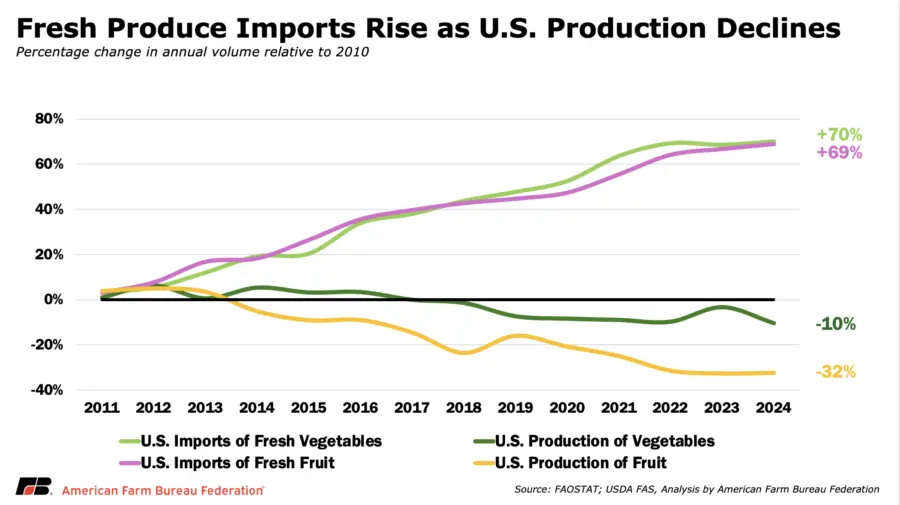
- Labor, input and regulatory expenses have climbed sharply, making it harder for domestic produce growers to recover costs, invest in their operations, and keep up with consumer demand. Since 2010, U.S. fruit production has declined 32% and vegetable production has fallen 10%, while fresh fruit and vegetable imports have each increased about 70%.
- Foreign supply still fills important seasonal gaps and supports year-round consumer demand, but imports are arriving in greater volumes during active domestic seasons, adding lower-cost competition when growers must market highly perishable crops.
- Import pressure extends across a range of fresh produce markets. The pattern varies by commodity, from higher year-round import volumes for lettuce and cabbage to sharper overlap during important blueberry, strawberry and tomato harvest windows. Together, these examples show that growing competition is not confined to a single crop, region or season.
- Growing dependence on foreign production can create food security risks. As U.S. production declines, more of the nation’s fresh produce supply becomes exposed to political instability, extreme weather, food-safety disruptions and regulatory decisions governed by other countries. Trade will remain essential, but a resilient food system requires U.S. farmers to be able to profitably grow fruits and vegetables here at home.
- Fresh produce markets run on strict timing. Fruits and vegetables are highly perishable, harvest windows are often short, and growers generally cannot store a crop while waiting for prices to improve. A few weeks of excess supply can determine whether a season ends in profit or loss.
- Imports are an essential part of this system. They fill seasonal production gaps, support year-round consumer demand, and strengthen integrated supply chains. Yet the rapid growth of foreign supply, and its increasing overlap with active U.S. harvest periods, has created legitimate concerns about downward price pressure during the narrow windows when domestic growers must sell their crops.
- Those pressures are particularly difficult for U.S. growers facing rising labor, regulatory, input and compliance costs that are often difficult to pass on to buyers. These competitive challenges do not diminish the broader value of agricultural trade. Rather, it highlights the need for a trade environment that preserves reliable consumer access while ensuring U.S. growers have a viable opportunity to compete.
Rising Costs, Falling Production and Greater Import Reliance
U.S. fruit and vegetable growers face an increasingly difficult cost environment. Many crops require extensive hand labor, specialized equipment and substantial spending on food safety, water quality, pest management and environmental compliance. A Cal Poly study of Salinas Valley lettuce operations found compliance costs rose from $109 per acre in 2006 to more than $1,600 per acre, increasing from about 1% to over 12% of total production costs. An Oregon State University study similarly estimated regulatory compliance costs of roughly $250 to $700 per acre across four cherry and pear operations, driven by H-2A requirements, worker safety and training, pesticide rules and worker housing. Those domestic cost pressures are compounded by significant differences in production costs abroad. An earlier University of Florida comparison, using 2013/14–2014/15 data, found labor costs averaged $2.81 for each eight-pound flat of Florida strawberries, compared with $1.27 for the same quantity exported from central Mexico, roughly 35 cents versus 16 cents per pound. Perishability, limited price transparency, and the lack of futures markets leave growers with few tools to absorb these added costs or manage sudden price declines.
Broader production expenses have also climbed sharply. Between 2020 and 2025, pesticide costs increased 25%, fuel rose 31%, fertilizer climbed 37%, and labor costs increased nearly 50%. Specialty crop farms averaged more than $466,000 in cash expenses in 2023, up 47% in two years, with labor accounting for nearly 40% of total costs.
As those pressures have constrained domestic production, imports have filled a growing share of U.S. supply. USDA estimates imports supplied 59% of U.S. fresh fruit availability and 35% of fresh vegetable availability in 2023, up from 50% and 20%, respectively, in 2007. Put differently, domestic sources accounted for about 41% of fresh fruit and 65% of fresh vegetables available to U.S. consumers. Between 2010 and 2024, fresh fruit and vegetable imports each increased by roughly 70%, while U.S. fruit production declined 32% and vegetable production fell 10%. Imports are not the sole cause of those declines, but they are increasingly filling the gap as the domestic sector struggles to meet demand. The U.S. population grew about 10% over that same period, meaning population growth explains some of the increase in overall demand, but is far smaller than the increase in import volumes. High labor, regulatory compliance and input costs make it harder for U.S. growers to expand production, recover costs and remain competitive, reinforcing the shift toward greater reliance on foreign supply.
Seasonality: Filling Gaps and Extending Windows
Import growth can mean different things depending on when a product arrives. Rising consumer demand for year-round fresh produce has encouraged investment in growing regions with seasons that complement U.S. production. Berry imports rise during winter when domestic supplies are more limited, orange imports peak as U.S. production declines in summer and fall, and pineapple imports remain relatively steady because domestic production is minimal.
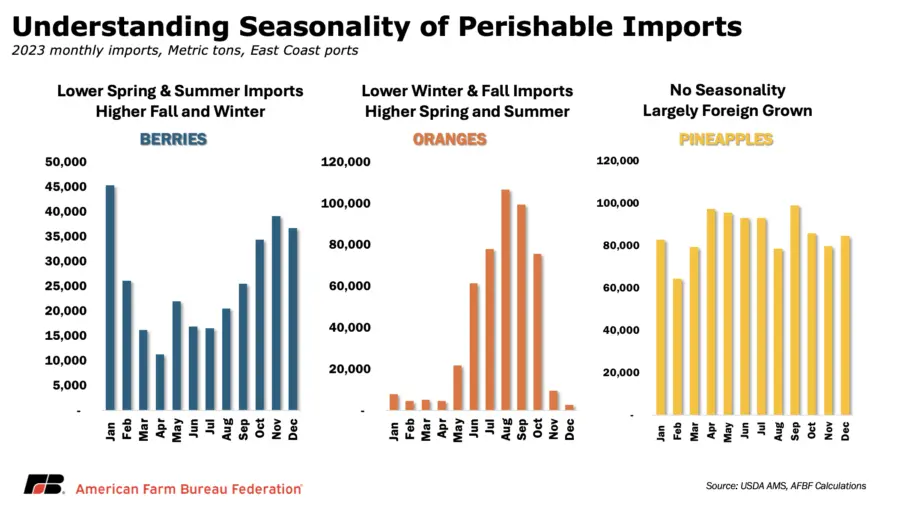
These trade flows give consumers access to products that were once available only seasonally and help retailers maintain consistent supplies throughout the year. Pressure on U.S. growers increases, however, when imports arrive earlier, remain later or grow during active domestic harvests. For highly perishable crops, even a short period of added supply can affect prices during the narrow window when growers must sell.
This expanding overlap, sometimes called market window creep, varies considerably by crop. The following examples range from imports that primarily fill domestic supply gaps to those that have become a larger presence during important U.S. harvest periods.
Watermelon: A Longer Import Season
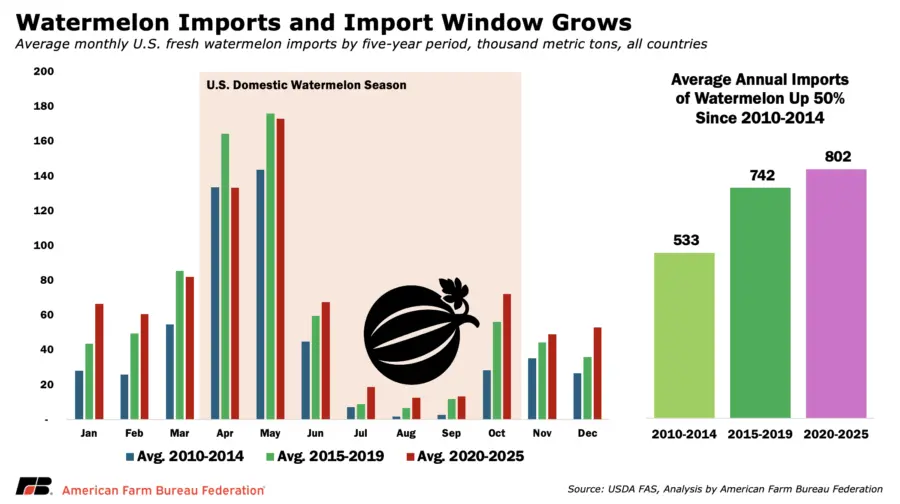
Watermelon offers a useful starting point because imports remain largely complementary to domestic production, but the edges of the import window have expanded. U.S. production runs from spring through early fall and typically peaks around July, led by Florida, Georgia, California and Texas. In 2024, domestic growers produced 1.68 million metric tons, while imports accounted for about 35% of U.S. supply and helped maintain availability before and after the main domestic season.
That said, average annual imports increased over 50%, from 533,000 metric tons in 2010–2014 to 802,000 metric tons in 2020–2025. Growth during the traditional April–May import peak was comparatively modest at 11%. However, June–July imports increased 67%, while October–December volumes nearly doubled.
The pattern suggests imports continue to serve their traditional role of filling seasonal gaps and meeting year-round demand, while also extending further into the shoulders of the U.S. season. For domestic growers, that means fewer months with limited import competition, including rising volumes as summer production is still moving through the market.
Tomatoes: Imports Expand into the U.S. Summer Harvest
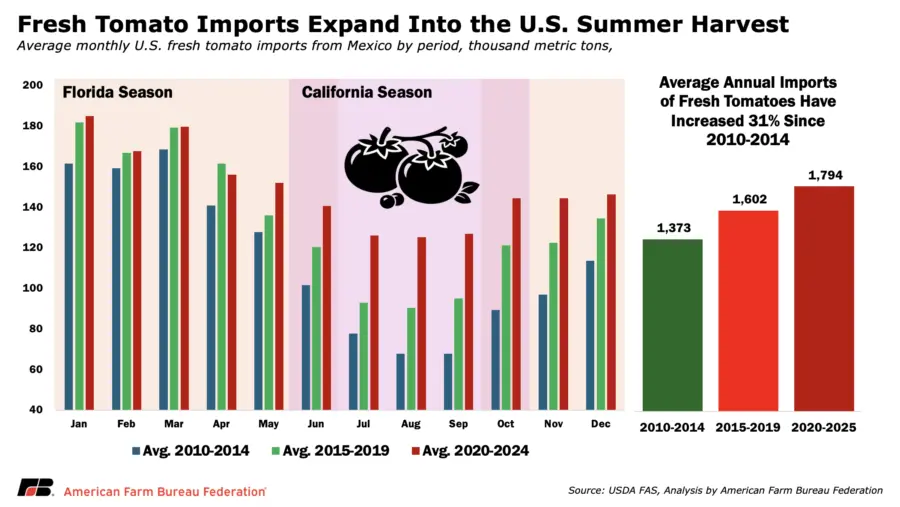
Fresh tomatoes are a year-round market, with Florida supplying much of the fall-through-spring crop, and California leading domestic shipments during summer. Mexico provides the overwhelming majority of U.S. fresh tomato imports, helping retailers maintain consistent supply across seasons. But as imports have grown, they have also expanded into what was once a pronounced summer trough in foreign supply. At the same time, U.S. fresh tomato production fell 24% between 2010 and 2024, and USDA estimates U.S. growers’ share of total fresh-tomato supply had fallen to 42% by 2017.
Average annual imports increased 31%, from about 1.37 million metric tons in 2010–2014 to 1.79 million metric tons in 2020–2024. Growth was much sharper during the domestic summer window: June–October imports rose 64%, while July–September volumes increased 77%. August and September imports each climbed about 85%, directly increasing competition during California’s primary season.
In July 2025, the Commerce Department ended the Tomato Suspension Agreement and imposed a 17.09% antidumping duty on most Mexican fresh tomatoes. Imports declined afterward: January–May 2026 shipments totaled about 748,000 metric tons, down 13% from the same period in 2025 and 13% below the 2022–2025 average. Every month was lower than a year earlier, including declines of 15% in January, 21% in February and 18% in May. While other market and production factors may also be involved, the change is consistent with a targeted trade remedy affecting shipment patterns. It also shows that specific pricing concerns can be addressed without treating the broader agricultural trade relationship as the problem.
Conclusion
The six crops analyzed represent a portion of the fresh produce market, but each shows how rising imports can increase pressure on U.S. growers. In some cases, that pressure comes from a steadily higher import baseline across the year. In others, foreign shipments have expanded directly into critical domestic harvest windows, when growers must quickly market highly perishable crops and recover their annual costs. Across most of the examples, U.S. production has been flat or declining even as imports have gained a larger share of the market.
That competition is especially difficult because many foreign suppliers operate with substantially lower labor, production and regulatory costs. U.S. growers face rising expenses for wages, worker housing, food safety, water quality, pesticide compliance and other requirements that are difficult to pass on to buyers. As those costs limit domestic acreage and investment, imports increasingly fill the resulting supply gap, reinforcing greater reliance on foreign production.
Trade remains essential to meeting consumer demand for affordable, year-round produce, and strong agricultural trading relationships benefit the broader food supply chain. But those benefits should not require accepting continued erosion of U.S. production capacity. Preserving a resilient produce sector will require reducing unnecessary domestic cost pressures, helping growers remain competitive and using targeted trade remedies when specific practices are proven to cause measurable harm. A dependable fresh produce supply ultimately requires both reliable trade partners and farmers who can afford to keep growing here at home.
Want more news on this topic? Farm Bureau members may subscribe for a free email news service, featuring the farm and rural topics that interest them most!