
Beaver's catastrophic flood shows the cost of delaying forest management
Author
Published
10/16/2026
I’m no firefighter, and I don’t rush toward fires. Yet over the years, I have found myself putting out fires that many either avoid entirely or watch in the abstract. They just seem to be happening around me more and more frequently.
When the adrenaline wanes, and you find yourself walking through the ash and soot to the sound of ravens and crows, it occurs to you that the disaster’s climax has yet to arrive. It comes later, when the scorched hills can no longer stop or even slow the flow of rainwater, making rafts of pinion and juniper skeletons and destructively flooding our fields, yards and homes.
For months after the fire that burned closest to our home, my kids had a trauma response to any smoke on the horizon. Not long ago, as I watched the shadow of a thundercloud wheel down a dirt road toward me, I thought that the only thing we should be feeling at the sight of a rainstorm is gratitude. But amidst a poorly managed forest ecosystem, the fear comes first.
When flash floods tore through the Cottonwood burn scar, flooding Beaver this past July, Mayor Matt Robinson sent for help. He got on FaceTime with his Congresswoman, Rep. Celeste Maloy, who was a part of that community for a decade.
In a matter of days, she’d pulled together U.S. Senator John Curtis, the United States Department of Agriculture official overseeing the Forest Service, a senior Interior Department advisor, the chairman of the House Natural Resources Committee, and Utah's own state leadership, standing together on an eroded highway looking at the catastrophe firsthand.
Maloy also sat down with local residents whose once award-winning tap water had just been declared unsafe to drink, hearing them directly, collecting their anguish to take to Washington and get something done.
Maloy has proposed a real solution to mitigating forest fire risk. She’s supported the Fix Our Forests Act since co-sponsoring it with both Republicans and Democrats in March 2025. The bill cuts through the web of cumbersome bureaucratic approvals that currently keeps the Forest Service from objectively thinning overgrown, fire-prone land before it burns. It expands fireshed planning so agencies can treat high-risk landscapes before disaster strikes instead of scrambling after, giving rural communities like Beaver a real chance.
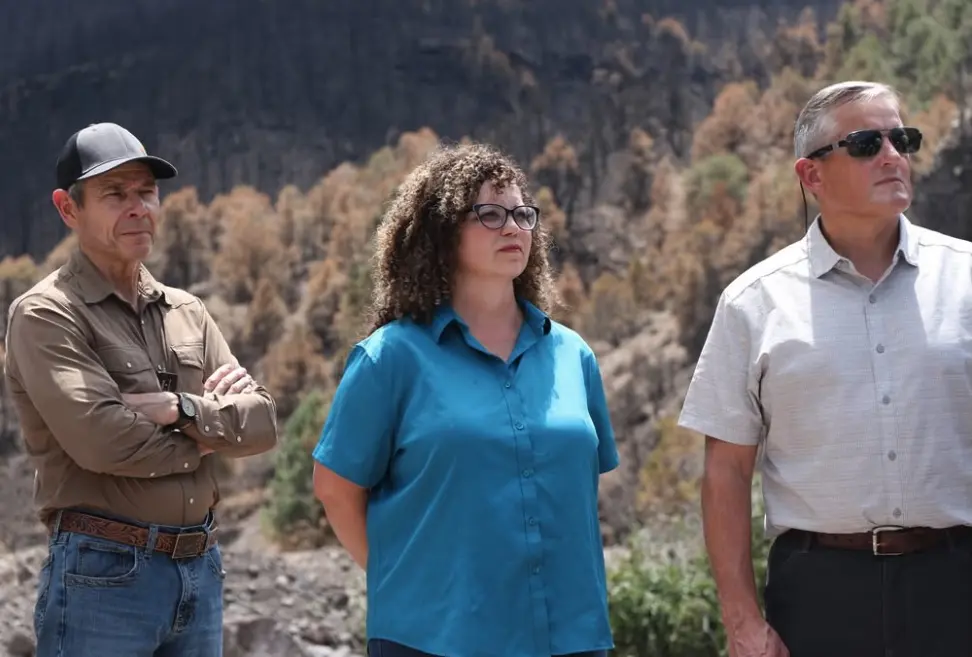 Sen. John Curtis (left) and Rep. Celeste Maloy (center) visit the site of damage in Beaver County. Image courtesy of Rep. Celeste Maloy.
This is not a fringe idea, but it may be a uniquely western one. The bill passed the House by an overwhelming bipartisan vote, and in the Senate it carries the support of Sen. Curtis, alongside Democrats Sen. John Hickenlooper of Colorado and Alex Padilla of California, and Republican Tim Sheehy of Montana. When was the last time you saw that kind of agreement in Washington on anything? Western leaders are finally hearing their actual constituents. And yet the bill has sat stalled in the Senate for a year and a half, while the forests above towns like Beaver become drier and more perilous.
Beyond pop-culture environmentalism, the daily experiences of Rural Utahns, who understand the nuances of Western ecology, deserve to be heard in Washington, too. Plant species are not simply names on paper where we work. Land management affects our homes, not our vacations. Those who come for their snapshot vacation to Zion National Park have powerful influence in Washington, through their tremendous social media followings and the wealthy environmental lobby organizations they support.
Such groups frame responsible vegetation treatment as a giveaway to logging interests. I understand this instinct, but it conflates refusing to manage an overgrown forest with protecting it. For the last 200 years, we’ve suppressed wildfire, and for the last 50 we’ve managed landscapes as static museum pieces. Forest management is like pruning a fruit tree, while failing to treat a forest is allowing it to grow into deadwood and suckers. A manageable fire can stimulate vegetation, but a fire with endless, unmanaged fuel will break the forest, sterilize the land and generate the kind of catastrophic flood that just hit Beaver.
When you live in these forests, you begin to feel their heartbeat. Our firefighters know the difference between management and destruction. We’ve felt so much of the latter that we understand this bill provides for the former.
Congress does not get many chances to pass something this practical, this bipartisan and this overdue. Beaver experienced what happens when we wait too long. Maloy and the House have done their job. The rest of the Senate needs to finish what they started, and our state’s welcome guests need to put their mouths where their money is, before the next fire becomes a naked scar, or before the last one becomes the next flood.
Kyle Wilson is a Washington County Farm Bureau member and past graduate of the American Farm Bureau's Partners in Advocacy Leadership (PAL) program. This article was first published by St. George News. It is reprinted here with permission of the publisher and the author. The ideas expressed are those of the author.
Want more news on this topic? Farm Bureau members may subscribe for a free email news service, featuring the farm and rural topics that interest them most!