
Helping County Assessors Understand Agriculture Beyond the Tax Code
Published
8/28/2026
Understanding Utah’s agricultural assessment laws requires more than reading statutes. It also requires understanding how farms and ranches operate. That’s why county greenbelt specialists paired classroom instruction with firsthand farm visits during a two-day training held earlier this month in Utah County.
The training brought together staff from the Utah State Tax Commission, county assessors’ offices and the Utah Farm Bureau to discuss Utah’s agricultural land-assessment laws, recent legislative changes and how those laws can be applied fairly and consistently across the state.
Utah’s Farmland Assessment Act, commonly known as “Greenbelt,” allows qualifying agricultural property to be assessed according to its productive agricultural value rather than its potentially higher market value for development or other uses. County greenbelt specialists administer the program by reviewing applications, evaluating whether properties meet the requirements and working with landowners to ensure compliance.

To qualify, a parcel generally must have at least five acres devoted to agricultural use, meet established production requirements and have two years of prior qualifying agricultural use. Property owners must also apply through their county assessor’s office.
Enacted in 1969 amid increasing development pressure, Greenbelt recognizes the economic realities of land actively used for agricultural production. Utah Farm Bureau policy supports protecting qualifying agricultural producers, enforcing eligibility requirements to maintain the program’s integrity and applying assessment standards uniformly throughout the state.
Understanding the Law
The first day focused on the Farmland Assessment Act and the Urban Farming Assessment Act. Utah State Tax Commission staff reviewed the laws, recent legislative changes and practical questions about their application, including when a rollback tax is required after property no longer qualifies.
Terry Camp, vice president of public policy for the Utah Farm Bureau, provided the perspective of farmers and ranchers and discussed the intent behind recent changes to Utah’s Greenbelt laws.
Among those changes is a pathway for farmers to participate in agricultural water optimization and temporary water-leasing programs without jeopardizing their Greenbelt status. The changes recognize that temporary water-management decisions do not necessarily mean the landowner has abandoned agricultural production. Utah Farm Bureau policy supports fallowing during drought, limited water supplies or as part of prudent farm management.
Camp’s participation also allowed Farm Bureau to hear directly from assessors about the challenges they encounter when implementing changes to the law.
“It was helpful for Farm Bureau to provide a policy perspective, but it was equally valuable to hear the questions and implementation challenges county assessors are facing,” Camp said. “Farmers and ranchers operate a wide variety of businesses, and sometimes understanding the operation is just as important as understanding the statute. We appreciate the opportunity to help assessors understand what agricultural production looks like on the ground and to be a resource when questions arise.”
Seeing Agriculture Firsthand
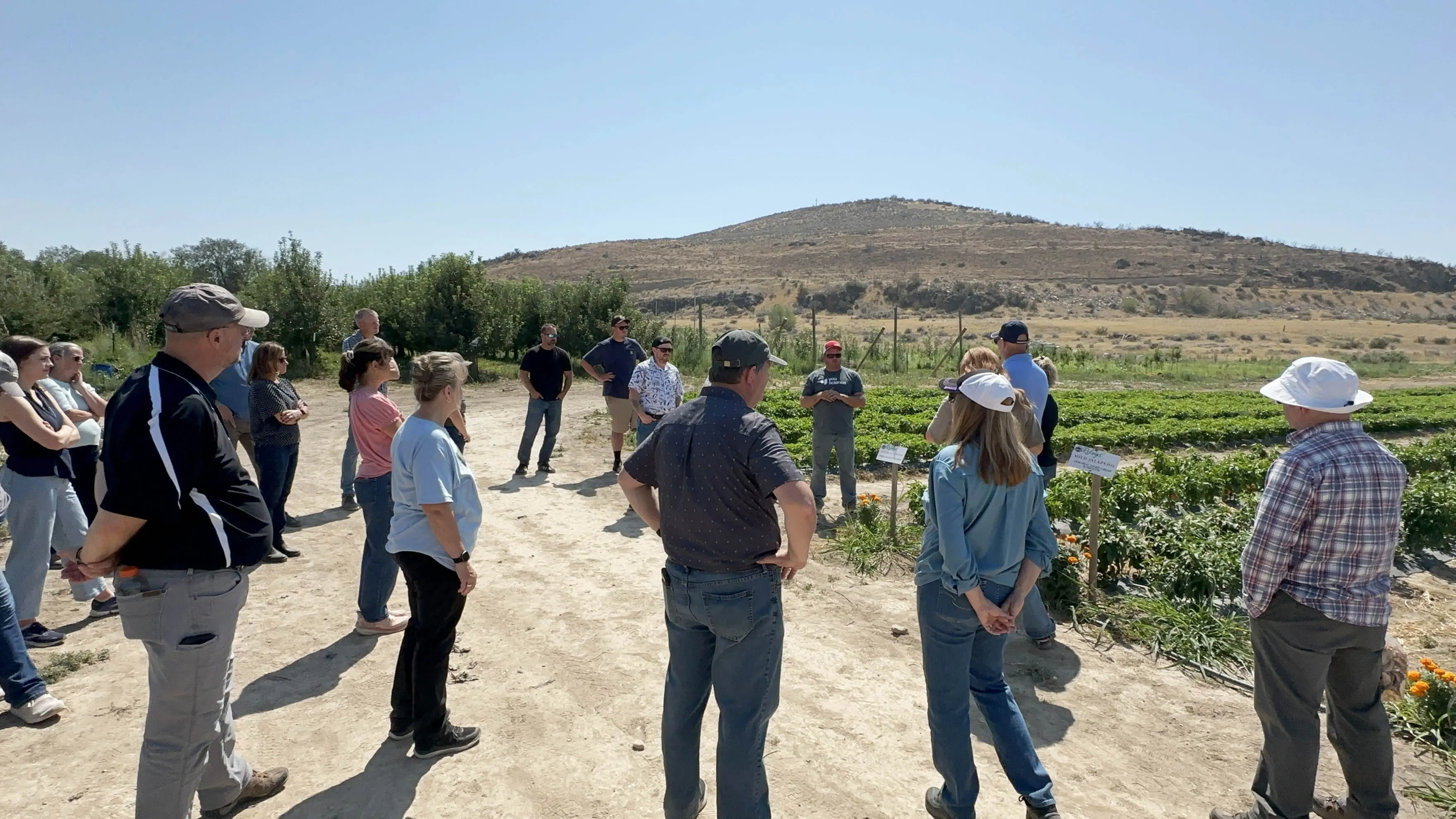
The second day included visits to several Utah County agricultural and processing operations:
- Fold of Liberty Farms in Spanish Fork
- Shepherd’s Processed Eggs in Spanish Fork
- Riley’s Orchards in Genola
- Bateman’s Mosida Farm in Elberta
Each stop offered a different perspective on agricultural production, management practices, infrastructure, and production timelines. The visits helped connect the standards discussed in the classroom with the operations those laws affect.
"Continuing education on the Farmland Assessment Act and Urban Farming Act helps County Assessor departments guide agriculture producers through the requirements to qualify," said Diane Garcia, Farmland Assessment Analyst for the Utah County Assessor's office and a member of the Utah County Farm Bureau Board. "Visiting diverse farming operations helps Assessor departments throughout the state. I look forward to this class every year and was grateful for the opportunity for Utah County to host and highlight a few of our agriculture producers."

Active agricultural use can look very different from one property to another. An orchard bears little resemblance to a row-crop farm, just as a livestock operation differs from an egg producer. Crops, livestock, fencing, barns, irrigation systems, equipment, and production records can all provide context for understanding how agricultural land is being used.
A farm participating in a temporary water program may also look different from one in full production, even though the underlying agricultural operation and the owner’s intent to continue farming remain unchanged.
Connecting the Law to the Land
Bringing assessors, state officials, and agricultural producers together helps connect statutory requirements with the realities of modern farming. Assessors gain a better understanding of the operations they evaluate, while farmers and ranchers benefit from a process that fairly and consistently recognizes qualifying agricultural use.
That shared understanding is increasingly important as Utah’s population grows and development pressure on agricultural land continues. An informed and consistent assessment process helps Greenbelt fulfill its purpose while preserving the program’s fairness and integrity.
Utah Farm Bureau appreciates the Utah State Tax Commission, the Utah County Assessor’s Office, and the participating farms for creating an opportunity to strengthen communication and improve understanding of Utah agriculture.
Want more news on this topic? Farm Bureau members may subscribe for a free email news service, featuring the farm and rural topics that interest them most!